
The Model Context Protocol (MCP) is an open standard that lets AI agents connect to external tools, data sources, and apps through standardised connectors. Introduced by Anthropic and now broadly adopted across the industry in 2026, MCP does for AI integrations what a universal port did for hardware: instead of building a custom bridge for every tool, you connect through one consistent interface.
If you have ever wondered why AI assistants suddenly seem able to read your files, query your database, or update your project tracker, MCP is usually the answer. This guide explains what MCP is in plain terms, why it matters for any business deploying AI, and how to adopt it with proper governance — the way we approach it when building AI agents.
What is MCP, in plain terms?
An AI model on its own only knows what it was trained on and what you type into it. To be useful in a business, it needs to reach live systems — your customer records, your documents, your calendar. MCP is the common language that makes those connections work the same way every time, regardless of which tool or which model is involved.
Without a shared standard, every connection is a one-off. Your AI assistant needs custom code to talk to your help desk, more custom code to read your file store, and yet more to query your database — each written, tested, and maintained separately. Multiply that by a handful of tools and a couple of models and you have a sprawling, fragile web of integrations that breaks whenever any piece changes. MCP exists precisely to end that sprawl by giving everyone one agreed way to connect.
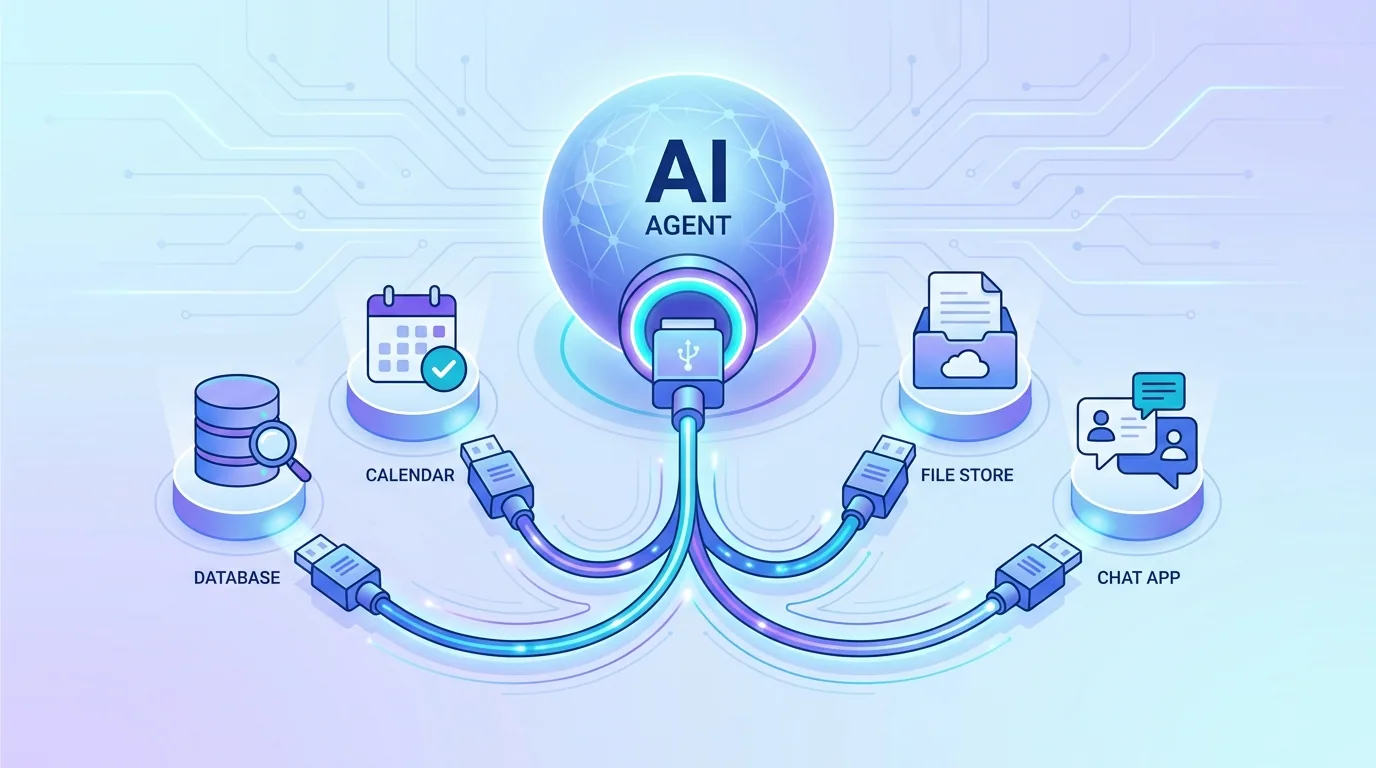
Think of it as a standard plug. Before standard plugs, every appliance might need its own custom socket. MCP defines the socket so any compliant tool can connect to any compliant AI agent. That standardisation is the whole point — it removes the bespoke, brittle integration work that used to sit between every model and every system.
Crucially, MCP is not a product you buy; it is a specification that tools and AI systems can implement. That distinction matters. A proprietary integration ties you to one vendor's roadmap and pricing. An open standard means many different tools and models can interoperate, and the connector you build today keeps working as the ecosystem evolves around it.
Why does MCP matter for businesses?
Before MCP, connecting an AI system to ten internal tools meant ten custom integrations to build, secure, and maintain — and starting over if you switched models. That cost and lock-in kept many useful AI projects on the shelf. MCP collapses that effort: build to the standard once, and your connectors are reusable across tools and largely portable across AI systems.
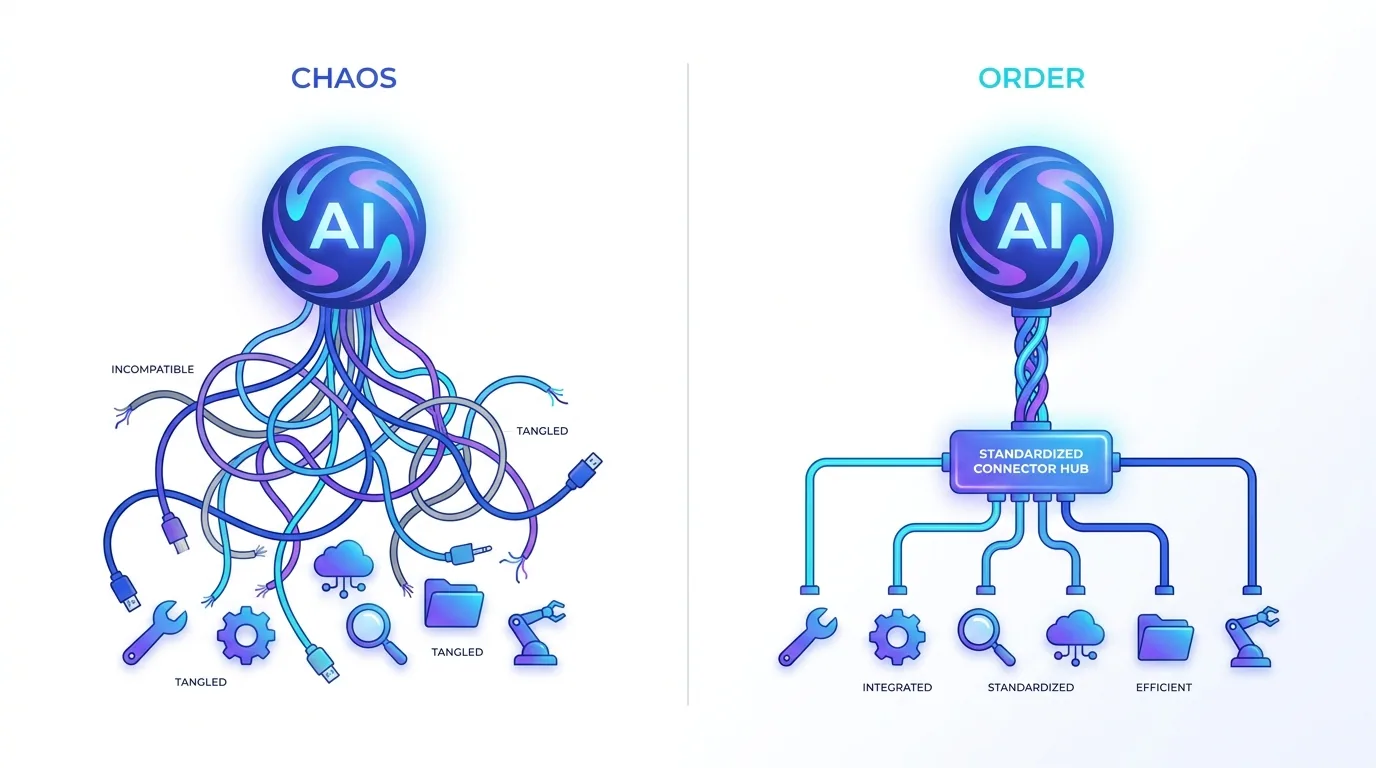
- Less integration work: connect to many tools through one consistent interface instead of building each bridge by hand.
- Reusability: an MCP connector you build or adopt can be reused across projects and AI systems.
- Less lock-in: because MCP is an open standard, you are not permanently tied to one model or vendor's integration layer.
- A growing ecosystem: with broad adoption, ready-made connectors exist for many common business tools.
How does MCP actually work?
Conceptually, MCP sits between an AI agent and the systems it needs to use. The agent expresses what it wants to do; the MCP connector exposes the available capabilities of a tool or data source in a standardised way; the protocol carries the request and the response. The agent doesn't need to know the private details of each system — only how to speak MCP.
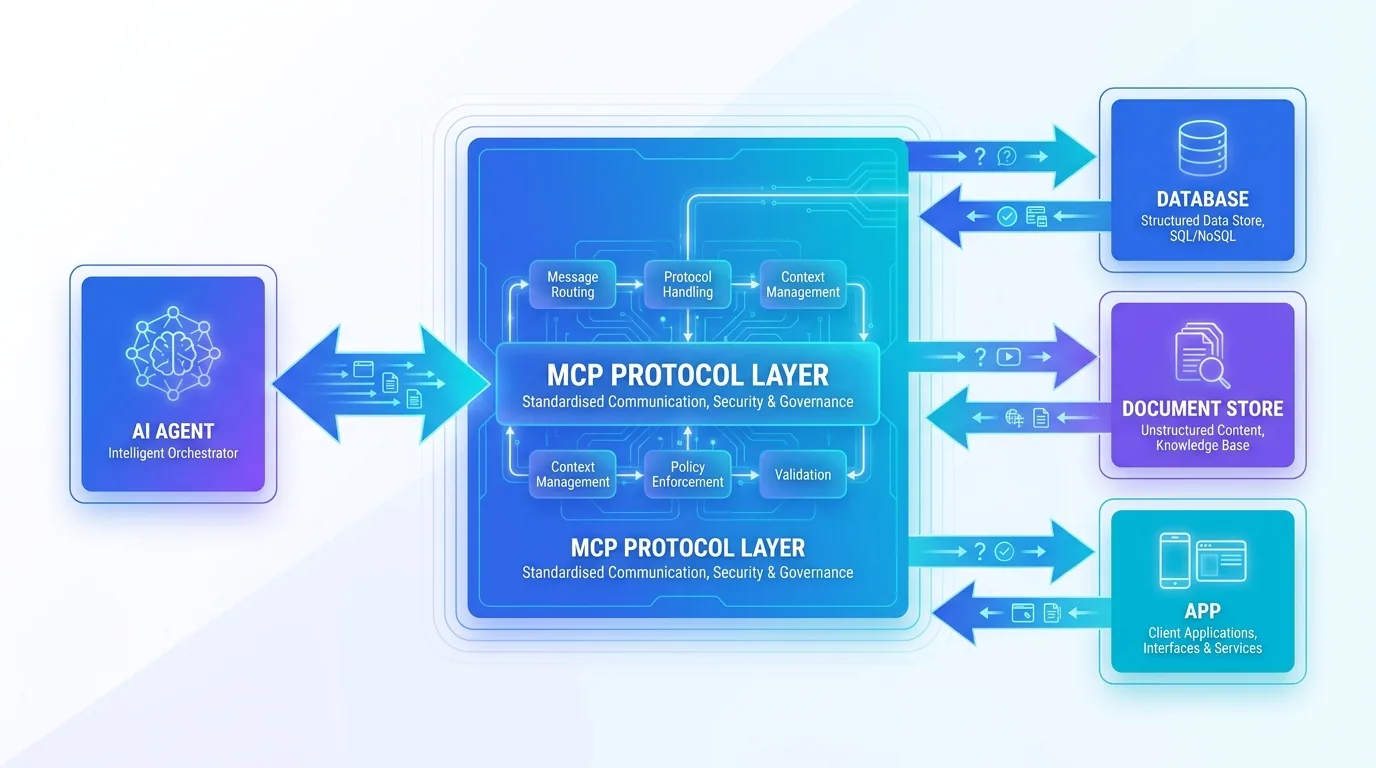
Because the interface is standardised, the same agent can swap one connector for another — say, moving from one document store to a different one — without rearchitecting the agent itself. That separation between the AI and the tools is what makes MCP-based systems easier to evolve over time. You can upgrade the model, change a data source, or add a capability without unpicking everything else, because each piece talks to the others through the same well-defined contract.
It also changes how teams think about building AI features. Instead of asking "how do we wire this one model to this one tool," the question becomes "what capabilities do we want to expose, and to whom." The plumbing is shared, so the energy goes into the parts that actually differentiate your product — the workflows, the policies, and the experience — rather than into reinventing connections that everyone needs.
MCP is quietly becoming plumbing — the kind of standard you stop thinking about because it just works. That is exactly when a standard has succeeded.
— Priya Nair, AI Solutions Architect, Fryntavo
How do you keep MCP secure and governed?
Connecting an AI agent to live systems is powerful, which means governance is not optional. The standard makes connection easy; it is your responsibility to control what each agent can reach and what it is allowed to do. Treat every connector as a doorway and decide deliberately who holds the key.
A helpful way to think about it: MCP standardises the connection, but it does not make decisions about trust on your behalf. The same connector that lets an agent read a customer record could, if misconfigured, let it change one. So the questions to settle early are which data each agent genuinely needs, which actions should be read-only versus write, and which steps must pause for a human. Get those boundaries right and the convenience of plug-and-play connectors becomes a strength rather than a risk.
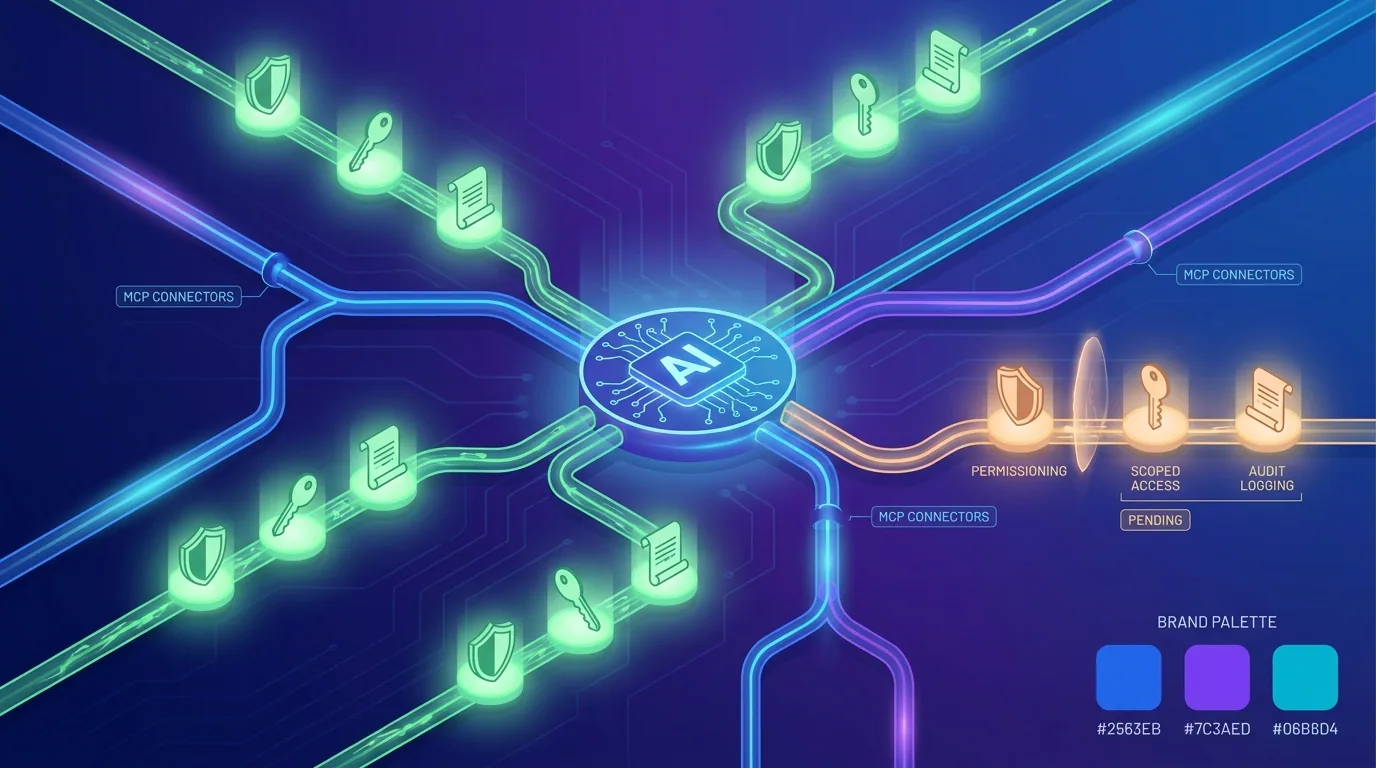
- Least privilege: grant each agent access only to the specific tools and data a task requires, never blanket access.
- Scoped permissions: define exactly which actions are read-only and which can change data, and gate sensitive ones.
- Credential management: keep secrets out of prompts and store them where the agent's runtime can inject them safely.
- Audit logging: record every connector call so you can trace what an agent did, when, and why.
How should a business adopt MCP?
Start by mapping which systems your AI use case genuinely needs to touch, then connect them one at a time with the narrowest sensible permissions. Use existing connectors where good ones exist, and build custom ones only where you must. Prove the workflow on a contained scope before widening access.
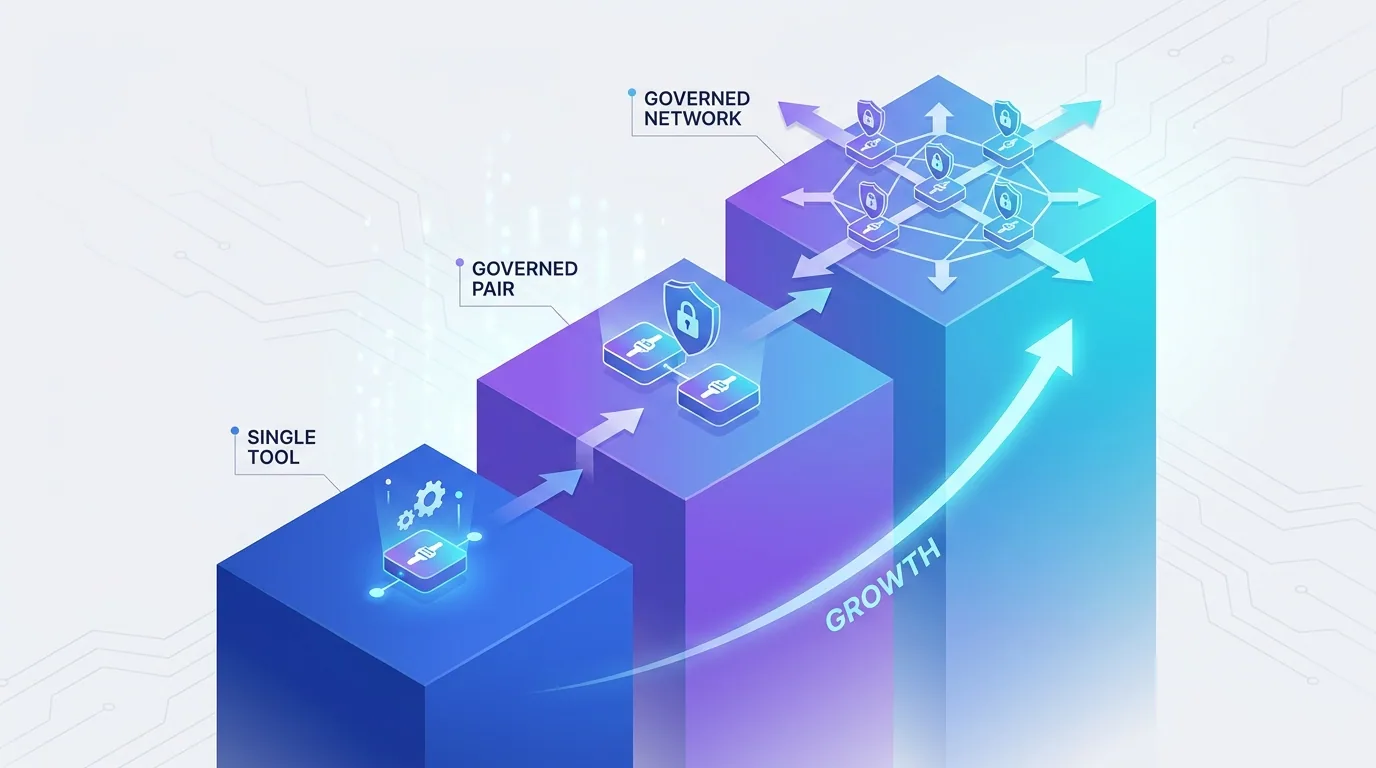
Adopted this way, MCP turns AI integration from a one-off engineering slog into a repeatable capability. Each connector you add safely makes the next AI project faster — which is how we help clients build connected, governed AI workflows that grow with the business.
Want to connect AI agents to your tools and data the right way? We design MCP-based integrations with the permissioning and governance to match.
Talk to Our AI TeamFrequently asked questions
What is the Model Context Protocol (MCP)?
MCP is an open standard, introduced by Anthropic, that lets AI agents connect to external tools, data sources, and apps through standardised connectors. It provides a common interface so an AI system can reach live systems without a custom integration for each one.
Why is MCP important?
MCP removes the need to build a separate, bespoke integration between every AI model and every tool. Build to the standard once and connectors become reusable across projects and largely portable across AI systems, which lowers cost, reduces lock-in, and speeds up new AI projects.
Is MCP vendor-specific?
No. Although MCP was introduced by Anthropic, it is an open standard with broad industry adoption in 2026. That openness is the point — it lets tools and AI systems from different providers interoperate through a common interface.
How does MCP work?
MCP sits between an AI agent and the systems it uses. Each connector exposes a tool or data source's capabilities in a standardised form, and the protocol carries requests and responses. The agent only needs to speak MCP, not the private details of each underlying system.
What is an MCP connector?
An MCP connector is a standardised adapter that exposes a specific tool or data source — such as a database, file store, or app — to an MCP-speaking AI agent. Connectors can be reused across projects and swapped without rearchitecting the agent.
How do I keep MCP integrations secure?
Apply least-privilege access so each agent reaches only the tools and data a task needs, scope which actions can read versus change data, manage credentials outside of prompts, and log every connector call for auditing. Governance is your responsibility even though connection is standardised.
How should a business start using MCP?
Map which systems your AI use case genuinely needs, then connect them one at a time with the narrowest sensible permissions. Reuse existing connectors where good ones exist, prove the workflow on a contained scope, and expand access gradually.
Can Fryntavo help with MCP integrations?
Yes. Fryntavo designs MCP-based integrations that connect AI agents to your tools and data, with the permissioning, credential handling, and audit logging needed to keep them governed. Book a call to discuss your systems and use case.
Ready to put this into action?
Fryntavo helps brands grow with web development, SEO, marketplace management, and AI automation. Book a free, no-obligation strategy call.
Book a Free Strategy Call