
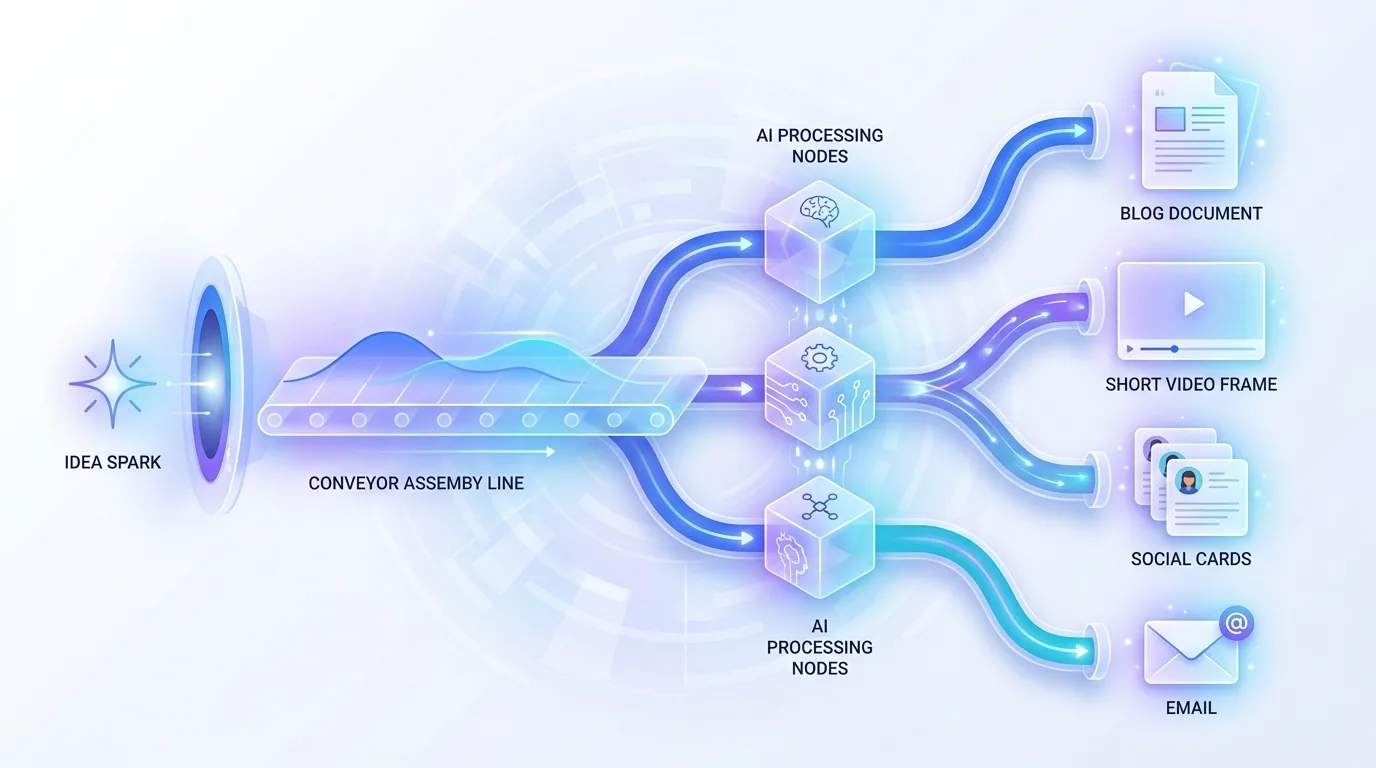
An AI content pipeline is an automated workflow that takes a single idea and carries it through research, drafting, editing, repurposing, and publishing — with AI doing the heavy lifting and humans steering the strategy and quality. Built well, it turns one strong piece of content into a month of assets across every channel, without the bottleneck of doing everything by hand.
In 2026, the teams winning at content are not the ones writing the most from scratch — they are the ones with the best systems. This guide walks through how to build a content automation workflow that genuinely scales output while protecting the quality, accuracy, and brand voice that make content worth reading. It is the exact blueprint we use when we build AI workflows for clients.
What is an AI content pipeline?
A content pipeline is the end-to-end path a piece of content travels from idea to published asset. An AI content pipeline automates the repetitive, time-consuming stages of that path — gathering research, structuring drafts, generating variations, and formatting for each platform — so your team spends its energy on direction, judgment, and the final polish that AI cannot fake.
The key mindset shift is to stop thinking about content as individual posts and start thinking about it as a production line. One pillar piece becomes the raw material for dozens of derivatives, and the pipeline handles the transformation automatically. This is what content automation means in practice.
The five stages of an AI content workflow
A reliable pipeline has five stages, each of which AI can accelerate. The art is knowing where automation adds value and where a human must stay in the loop.
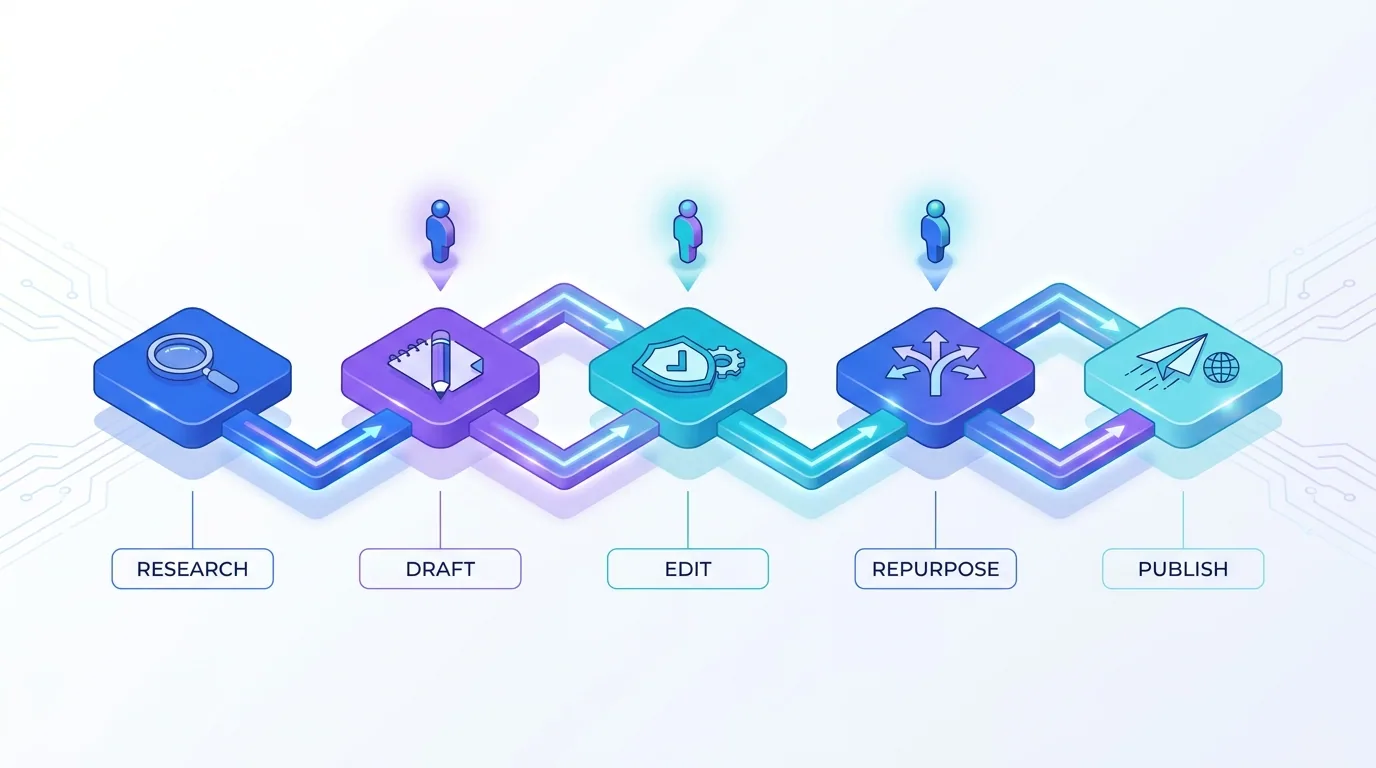
- Research and ideation — AI pulls keywords, questions, competitor gaps, and audience pain points into a structured brief.
- Drafting — AI generates a first draft from the brief, following your outline, structure, and voice guidelines.
- Editing and fact-checking — a human reviews for accuracy, nuance, and brand fit; AI assists with grammar and consistency.
- Repurposing — the approved piece is automatically reshaped into social posts, an email, a video script, and more.
- Publishing and scheduling — formatted assets are pushed to each platform on schedule, with metadata and links applied.
Notice where the human sits: at the brief and at the edit. Those two checkpoints are where strategy and trust are protected. Everything around them — the mechanical reshaping and distribution — is where automation pays off most.
Repurposing: where the real leverage lives
Repurposing is the single highest-leverage part of the pipeline. A well-researched 1,500-word article already contains the substance for a week of LinkedIn posts, a thread, a newsletter, a short-form video script, and a handful of quote graphics. The hard work — the thinking — is already done; the pipeline simply re-packages it for each audience and format.
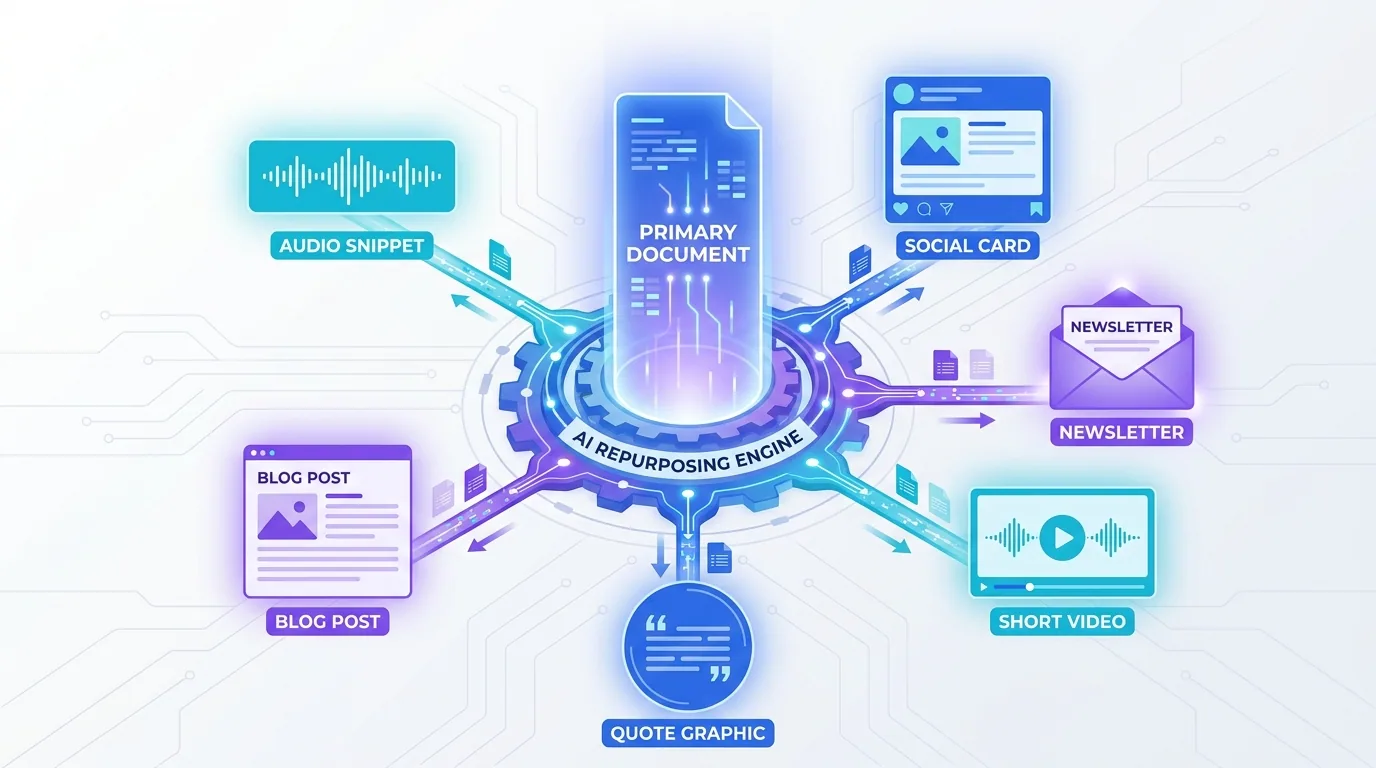
The trick is to tailor, not just copy. A LinkedIn post needs a different hook than an Instagram caption; an email needs a different rhythm than a blog. A good pipeline encodes those format rules so each derivative feels native to its platform rather than obviously recycled. That nuance is what separates a content engine from a spam machine.
Keeping quality and brand voice intact
The biggest risk of content automation is flooding the world with bland, generic, or inaccurate material. AI search engines and audiences both punish that — thin, undifferentiated content gets ignored, and factual errors damage trust fast. The pipeline must be engineered for quality, not just speed.
- Feed the AI your voice — provide a style guide, real examples, and approved phrasing so drafts sound like you, not like everyone.
- Always fact-check — treat AI output as a first draft from a fast intern, never as a finished, verified source.
- Add original substance — inject your own data, examples, opinions, and experience so the content is genuinely worth citing.
- Keep a human editor — the final approval gate is non-negotiable; it is what protects your brand and your credibility.
Automation should remove the busywork, not the brain. The fastest way to ruin a content pipeline is to remove the human who makes it good.
— Priya Nair, AI Solutions Architect, Fryntavo
Done this way, automation actually raises quality, because your team spends its limited time on the parts that matter — sharper angles, better examples, more original insight — instead of wrestling with formatting and reposting. This is also how you stay aligned with modern SEO and answer-engine expectations, which reward depth and expertise over volume.
How to build your pipeline step by step
You do not need to automate everything on day one. The most durable pipelines are built incrementally, proving each stage before connecting the next. Start where the pain is greatest — usually repurposing and distribution — and expand from there.

- Document your current process — map every step a piece of content takes today and time each one to find the bottlenecks.
- Codify your standards — write the brief template, the voice guide, and the format rules the AI will follow.
- Automate one stage — start with repurposing or scheduling, the lowest-risk, highest-volume wins.
- Connect the stages — link your tools and AI agents so content flows automatically with human checkpoints intact.
- Measure and refine — track output, engagement, and quality, and tune the prompts and rules every few weeks.
When we build these systems for clients, the agents themselves do the routing and reshaping while connected through automated AI workflows, so a single approved draft fans out to every channel without anyone copy-pasting. The human stays in control of strategy; the machine handles the labour.
Measuring whether your AI content pipeline is working
Volume is the easiest metric to inflate and the least meaningful on its own. Judge the pipeline by outcomes: are you publishing more and holding quality, is engagement steady or rising, and is your team spending its reclaimed time on higher-value work? If output went up but engagement collapsed, the pipeline is producing noise, not content.
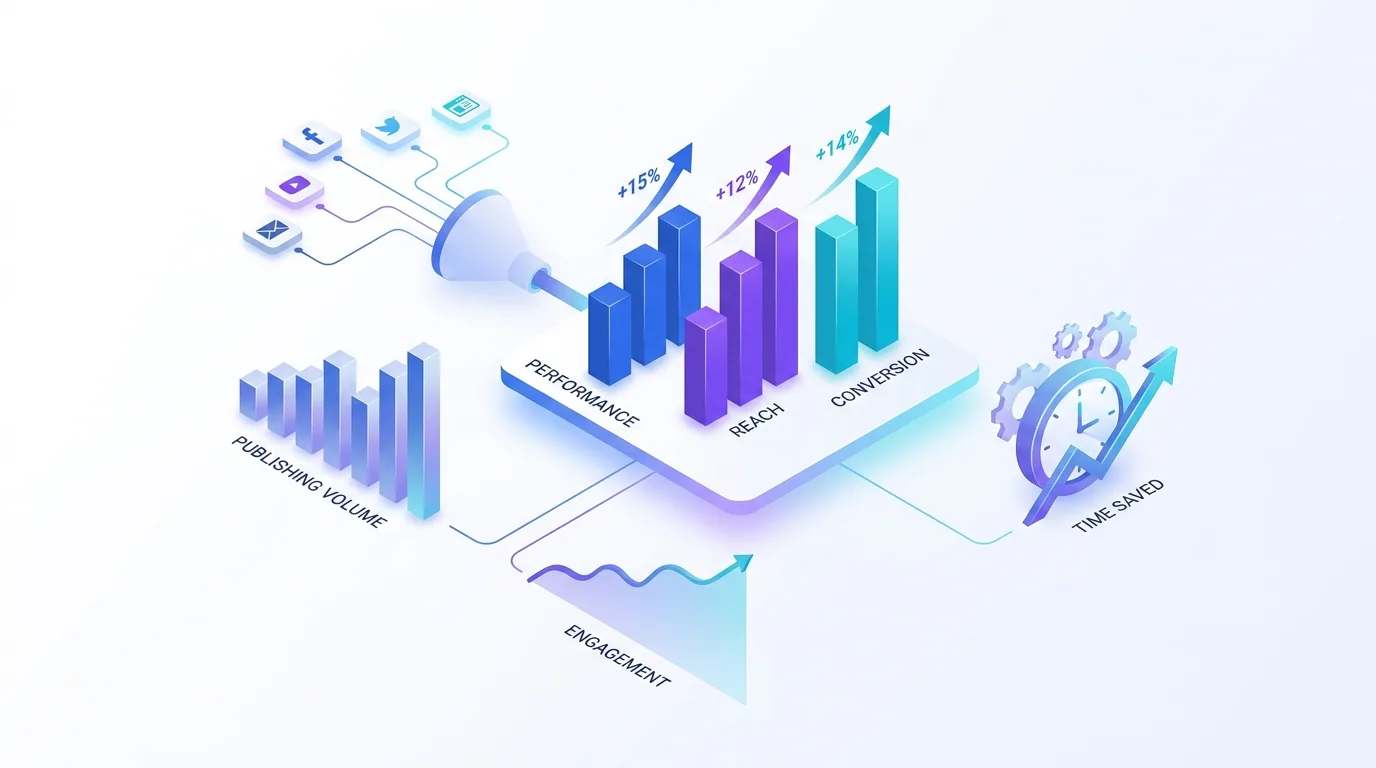
An AI content pipeline is not about replacing creativity — it is about removing the friction between a good idea and a published, well-distributed asset. Get the system right and you publish more, on more channels, with less effort, while your best people focus on the strategy and originality that no machine can replicate.
Want a content engine that turns one idea into a month of multi-channel assets — without losing your voice or quality? Let us design and build your AI content pipeline.
Book a Free Automation CallFrequently asked questions
What is an AI content pipeline?
An AI content pipeline is an automated workflow that moves a single idea through research, drafting, editing, repurposing, and publishing, with AI handling the repetitive stages and humans steering strategy and quality. The goal is to turn one strong piece into many assets across channels.
Can AI fully automate content creation?
Not without sacrificing quality. AI can automate research, first drafts, repurposing, and distribution, but a human should still own the strategy, fact-checking, and final approval. The best pipelines keep humans at the brief and the edit while automating the labour around them.
How does content repurposing with AI work?
Repurposing takes one approved pillar piece and automatically reshapes it into social posts, emails, video scripts, and graphics, each tailored to its platform rather than copied. Because the research and thinking are already done, repurposing delivers the highest leverage in the pipeline.
Will an AI content pipeline hurt my SEO?
Only if it produces thin, generic content. AI search engines reward depth, originality, and expertise, so a good pipeline must add your own data, examples, and human editing. Done well, automation frees time to make content better, which helps SEO rather than hurting it.
How do I keep my brand voice when using AI?
Feed the AI a clear style guide, real examples of your writing, and approved phrasing, then keep a human editor as the final gate. The model should follow your voice rather than inventing a generic one, and the editor ensures every piece sounds like your brand.
Where should I start when automating content?
Start by documenting your current process and timing each step to find the bottlenecks, then automate the lowest-risk, highest-volume stage first, usually repurposing or scheduling. Prove each stage before connecting the next so the system stays reliable.
How do I measure if my content pipeline is working?
Look at output, engagement, and reclaimed time together rather than volume alone. If you are publishing more while engagement holds or rises and your team spends its freed time on higher-value work, the pipeline is healthy; if engagement drops, it is producing noise.
Can Fryntavo build a content automation workflow for us?
Yes. Fryntavo designs and builds AI content pipelines and workflows that connect your tools and agents, with human checkpoints for strategy and quality. Book a free automation call and we will map your process and build the system around it.
Ready to put this into action?
Fryntavo helps brands grow with web development, SEO, marketplace management, and AI automation. Book a free, no-obligation strategy call.
Book a Free Strategy Call