
An AI customer support agent is a system that reads a customer's question, finds the right answer from your own knowledge, and either resolves the issue or hands it to a human — automatically. Done well in 2026, it deflects the repetitive tickets that drown support teams while routing anything sensitive or complex to a person. The key to building one that customers trust is grounding it in your real content and giving it clear rules for when to escalate.
This guide lays out how to build that agent end to end: retrieval so it answers from facts instead of guessing, guardrails so it behaves predictably, and escalation so it knows its limits. It is the same blueprint we follow when we build AI support agents for clients.
What is an AI customer support agent?
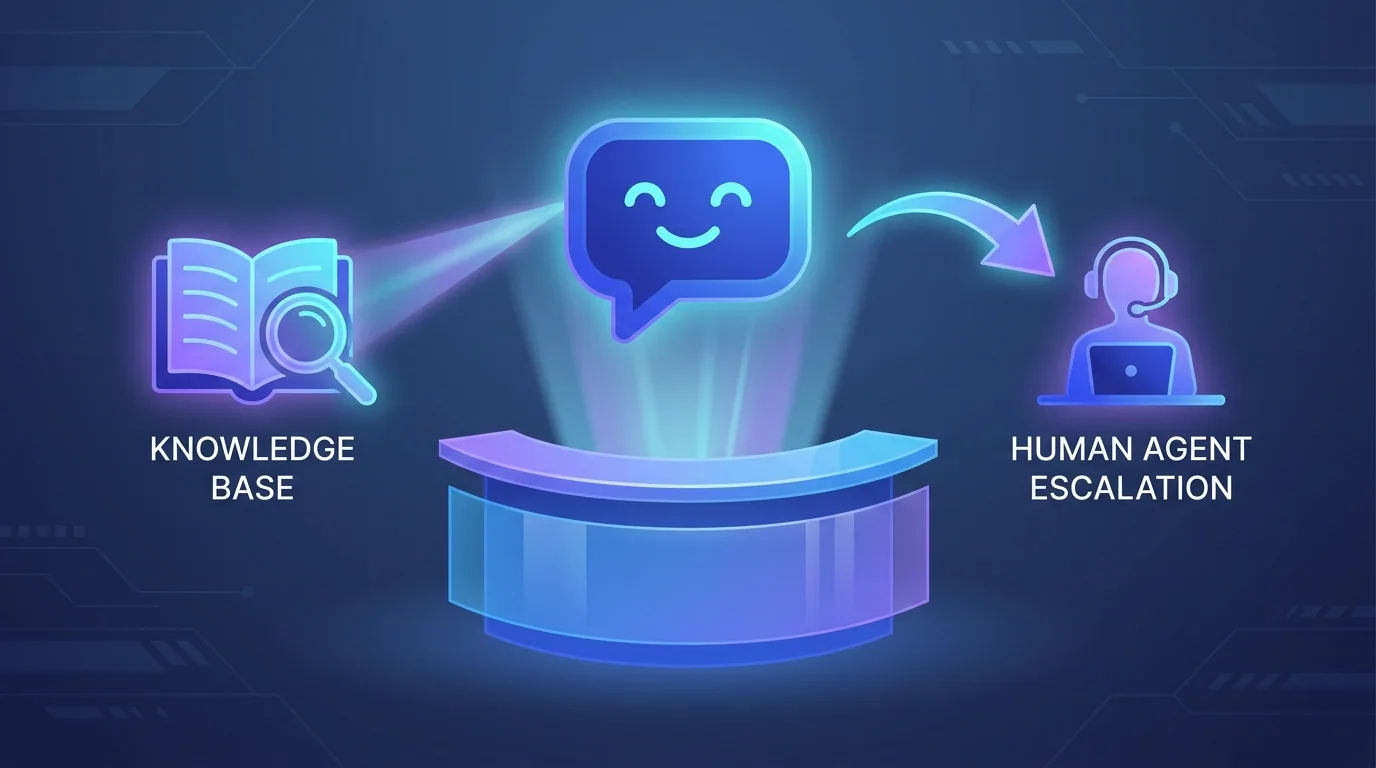
An AI support agent goes beyond a scripted chatbot. A scripted bot follows decision trees and breaks the moment a customer phrases something off-script. An agent understands the question in natural language, retrieves the relevant policy or article, composes a clear answer, and can take actions — checking an order status, creating a ticket, or escalating — within the boundaries you define.
The goal is not to replace your support team. It is to handle the high volume of routine, repetitive questions instantly and around the clock, so your human agents can focus on the conversations that genuinely need judgement, empathy, or authority.
That framing matters because it sets realistic expectations. An AI support agent is not a magic box that resolves everything — it is a first line that absorbs the predictable load. "Where is my order," "how do I reset my password," "what is your return policy": questions like these make up a large share of most support queues, they have correct answers in your documentation, and they are exactly what an agent handles well. Removing them frees your team for the conversations that actually move customer loyalty.
Why is RAG the foundation of a good support agent?
The single most important design choice is Retrieval-Augmented Generation (RAG). Instead of relying on the model's general knowledge — which can be outdated or simply wrong about your business — RAG retrieves the most relevant passages from your own documentation at answer time and instructs the agent to respond *from those passages*. This is what keeps answers accurate and current.
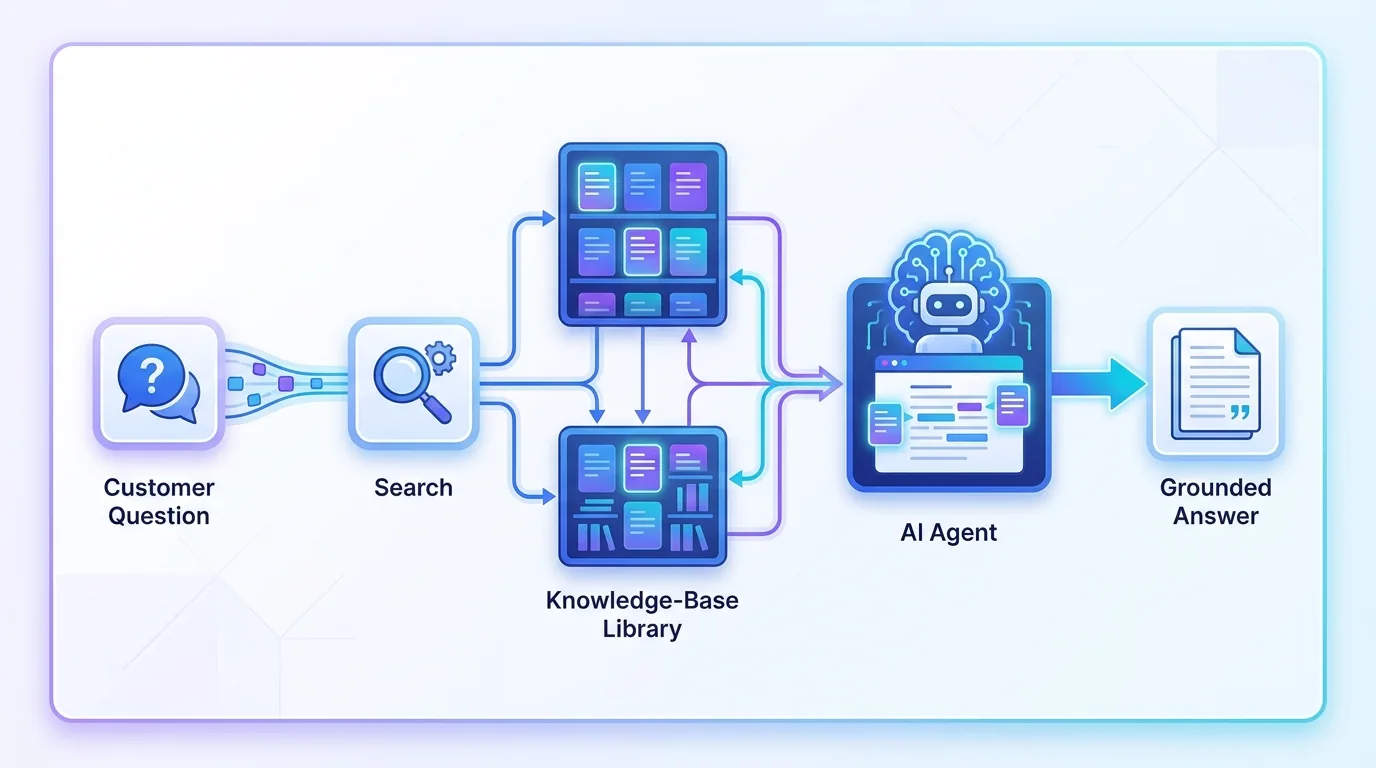
RAG also solves the trust problem. Because answers are grounded in retrieved sources, the agent can cite where information came from, and you can keep it current simply by updating your knowledge base — no retraining required. A well-maintained help centre directly becomes a smarter support agent.
- Index your knowledge: ingest help articles, policies, and FAQs into a searchable store.
- Retrieve on each question: find the passages most relevant to the customer's specific query.
- Ground the answer: instruct the agent to answer only from retrieved content and to say when it doesn't know.
- Cite sources: surface the underlying article so customers and agents can verify the response.
- Keep it fresh: update the knowledge base as products and policies change so answers stay correct.
How do you set guardrails so the agent behaves?
An agent that improvises is a liability. Guardrails define the lane it must stay in: what it may answer, what it must never claim, and how it speaks. The most important rule is simple — if the retrieved content does not support an answer, the agent should say it isn't sure and offer to escalate, never invent a response.
- Scope: restrict the agent to topics covered by your knowledge base, and decline politely outside that scope.
- No fabrication: require it to answer only from retrieved sources and to admit uncertainty rather than guess.
- Tone and brand: define a consistent voice so every reply sounds like your company.
- Sensitive topics: route billing disputes, cancellations, complaints, and anything legal or safety-related straight to a human.
- Action limits: gate any consequential action — refunds, account changes — behind confirmation or human approval.
A support agent earns trust by knowing what it doesn't know. The phrase 'let me connect you with a specialist' is a feature, not a failure.
— Priya Nair, AI Solutions Architect, Fryntavo
When should the agent escalate to a human?
Great escalation is what separates a helpful agent from a frustrating one. The agent should hand off the moment it is out of its depth — and the handoff must be seamless, carrying the full conversation context so the customer never has to repeat themselves. Escalation is a confidence and risk decision, not an afterthought.
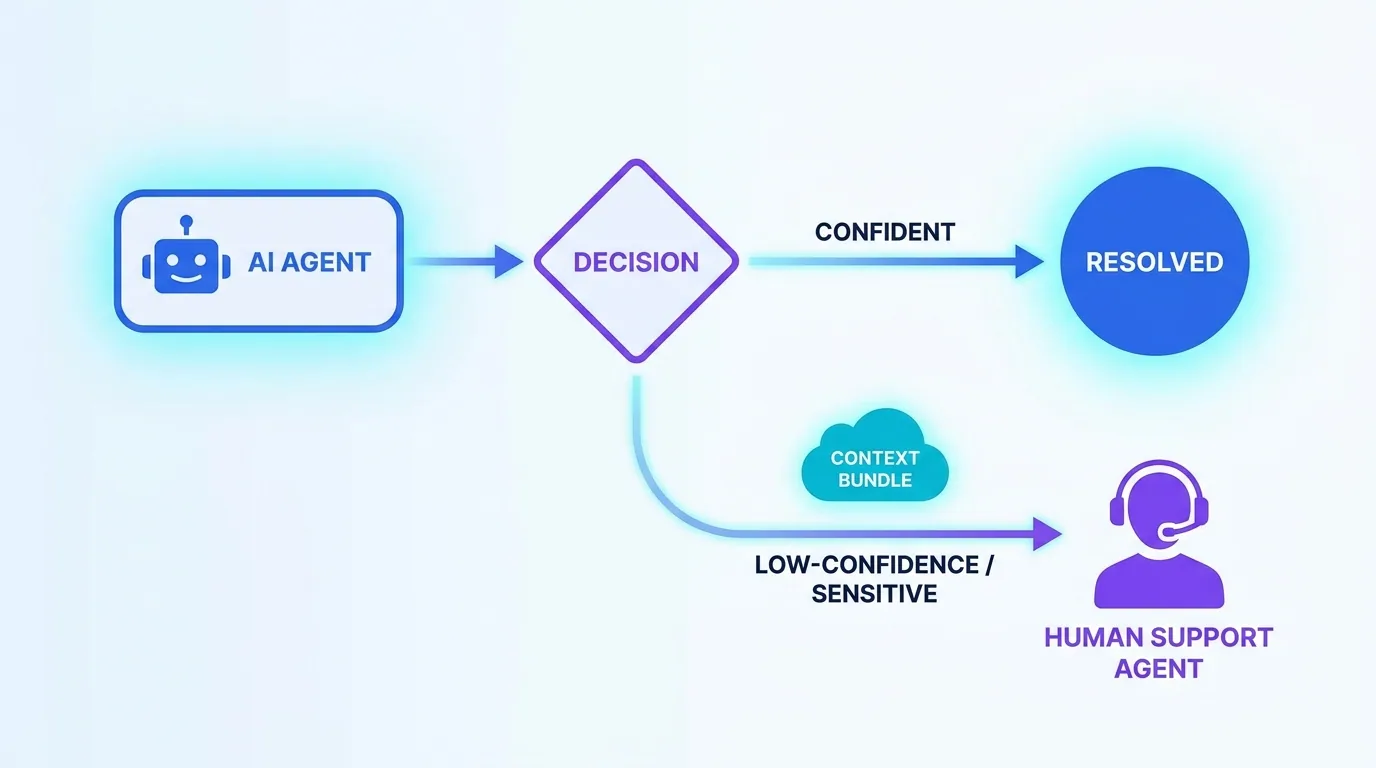
- Low confidence: when retrieval returns weak matches or the agent is unsure, escalate rather than risk a wrong answer.
- Sensitive intent: complaints, cancellations, billing disputes, and emotional or urgent messages go to a person.
- Repeated failure: if the customer rephrases the same problem twice, stop looping and hand off.
- Explicit request: when a customer asks for a human, transfer immediately and without friction.
- Full context: pass the entire transcript and any account details so the human picks up exactly where the agent left off.
How do you measure and improve the agent?
Launch is the start, not the finish. Track the metrics that reflect real customer outcomes — deflection rate, resolution accuracy, escalation rate, and customer satisfaction — and review escalated and low-rated conversations to find gaps in your knowledge base or guardrails. Every escalation is a lesson about what to document or fix next.
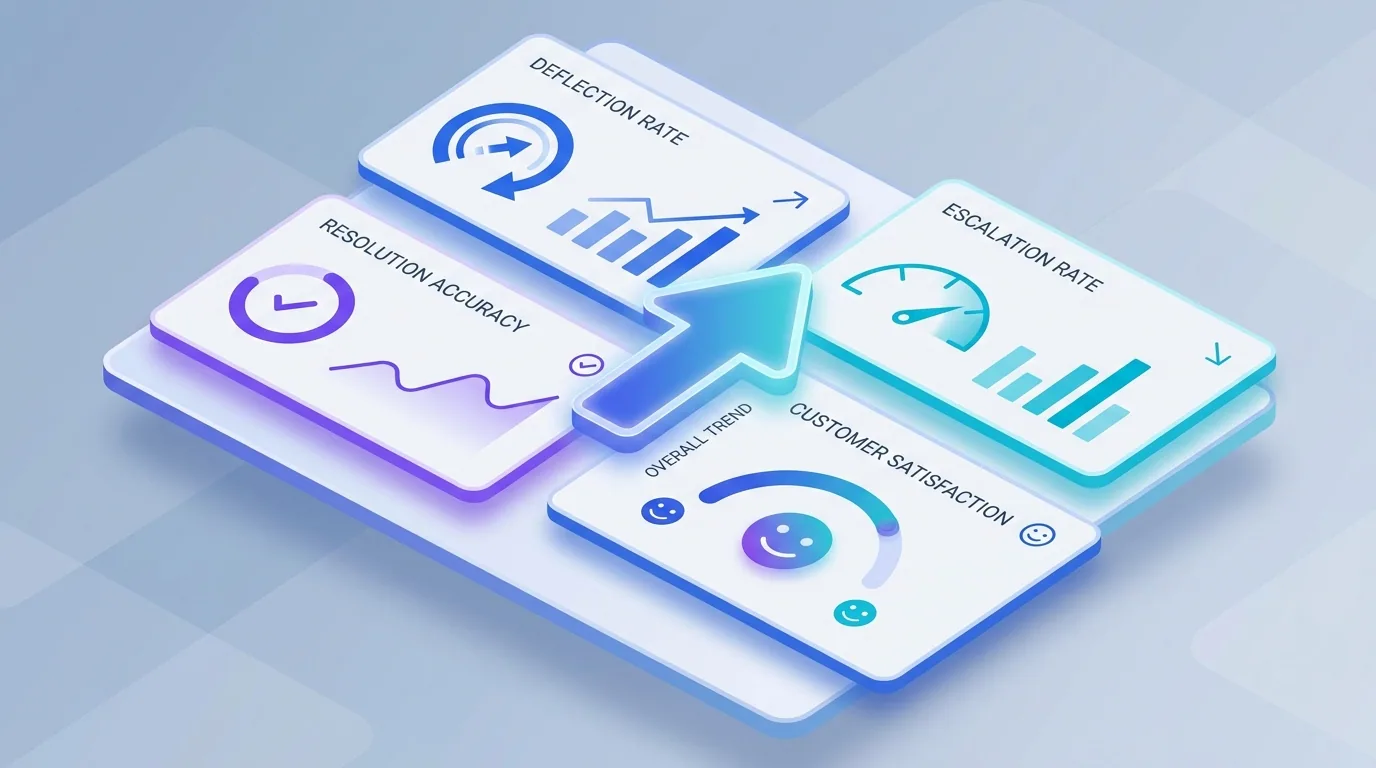
This feedback loop compounds. As you tighten the knowledge base and refine escalation rules, deflection rises and accuracy improves, while the conversations reaching your team get more valuable. The agent quietly gets better every week it runs.
What's the right way to roll one out?
Don't switch your whole support operation to AI overnight. Start with a contained scope — one product line or a defined set of common questions — and keep humans closely reviewing the agent's answers at first. As accuracy and confidence hold, widen the topics it covers and the actions it can take. A narrow agent that is reliably right beats a broad one customers learn to distrust.
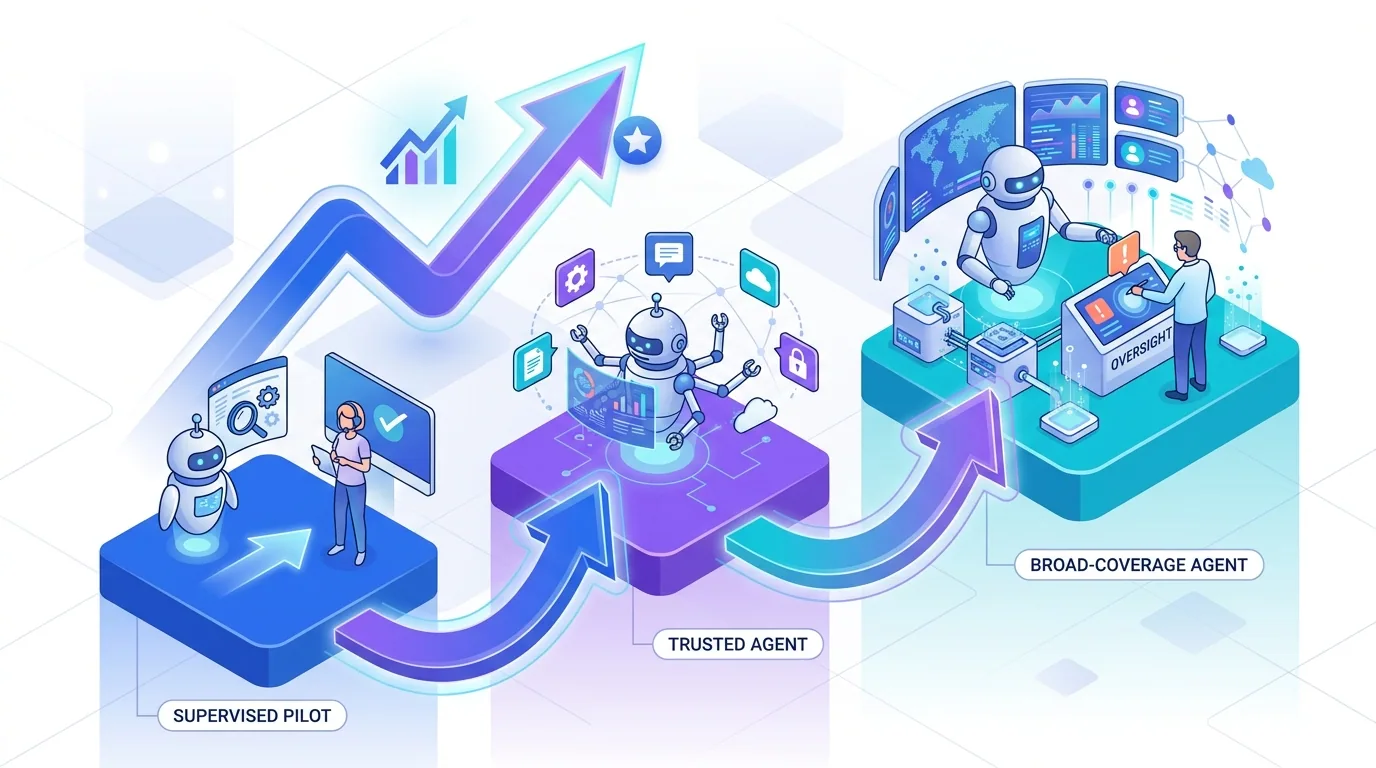
Build it on solid retrieval, sensible guardrails, and graceful escalation, and an AI support agent becomes one of the highest-ROI automations a business can deploy. That is exactly the kind of dependable customer service automation we design, integrate, and tune for our clients.
Ready to deflect routine tickets and free up your support team? We build RAG-grounded AI support agents with the guardrails and escalation to keep customers happy.
Build Your Support AgentFrequently asked questions
What is an AI customer support agent?
An AI customer support agent is a system that understands a customer's question in natural language, retrieves the right answer from your own knowledge, and either resolves the issue or escalates it to a human. Unlike a scripted chatbot, it can reason about the request and take limited actions within set boundaries.
What is RAG and why does it matter for support?
RAG, or Retrieval-Augmented Generation, retrieves the most relevant passages from your documentation at answer time and instructs the agent to respond from them. It matters because it keeps answers accurate and current, lets the agent cite sources, and means you update knowledge rather than retrain a model.
Will an AI support agent replace my human team?
No. A well-designed agent handles the high volume of routine, repetitive questions so your human agents can focus on conversations that need judgement, empathy, or authority. Escalation to humans is a core feature, not a sign of failure.
How does an AI support agent know when to escalate?
It escalates when retrieval confidence is low, when the intent is sensitive (complaints, cancellations, billing disputes), when the customer rephrases the same problem repeatedly, or when they explicitly ask for a human. A good handoff carries the full conversation context to the human agent.
How do you stop an AI support agent from making things up?
Ground it with RAG so it answers only from retrieved sources, and set a guardrail requiring it to admit uncertainty and escalate when the content doesn't support an answer. Restricting its scope to your knowledge base and gating consequential actions also prevents fabrication.
What metrics should I track for an AI support agent?
Track deflection rate, resolution accuracy, escalation rate, and customer satisfaction. Reviewing escalated and low-rated conversations reveals gaps in your knowledge base and guardrails, creating a feedback loop that steadily improves the agent.
How should I roll out an AI support agent?
Start with a contained scope, such as one product line or a set of common questions, and keep humans reviewing answers closely at first. Widen the topics and actions the agent handles as accuracy and confidence prove out. A narrow, reliable agent earns more trust than a broad, error-prone one.
Can Fryntavo build an AI customer support agent for us?
Yes. Fryntavo builds RAG-grounded support agents with clear guardrails and graceful escalation, integrates them with your help content and tools, and tunes them with ongoing measurement. We start with a supervised pilot and expand as reliability holds. Book a call to begin.
Ready to put this into action?
Fryntavo helps brands grow with web development, SEO, marketplace management, and AI automation. Book a free, no-obligation strategy call.
Book a Free Strategy Call