


A brand style guide is the rulebook that keeps your visual identity consistent everywhere your brand appears — your logo, colors, typography, imagery, and voice, all documented in one place. To create one in 2026, you define each of those elements with clear usage rules, then make the guide easy for anyone on your team to follow. The payoff is a brand that looks unmistakably like itself across every channel.
Consistency is not a cosmetic nicety — it is what builds recognition and trust. Brands that show up the same way everywhere feel more credible and more memorable. This guide walks through exactly what to include in your brand guidelines, in the order we structure them when our graphic design team builds brand books for clients.
What is a brand style guide and why do you need one?
A brand style guide — sometimes called brand guidelines or a brand book — is a document that defines how your brand looks, sounds, and behaves. It is the single source of truth that a designer, a marketer, a freelancer, or an AI tool can reference to produce on-brand work without guessing.
Without one, every new hire, agency, and template reinvents the brand slightly differently, and the identity slowly erodes into a blurry mess. With one, anyone can create materials that look like they came from the same company — because they followed the same rules. That coherence is what turns a logo into a recognisable brand.
There is a new reason this matters in 2026, too. More of your brand's output is now produced by AI tools and external collaborators than ever before, and those tools and people cannot absorb your brand by osmosis — they need explicit instructions. A well-written style guide is effectively the prompt for your entire brand: feed it to a designer, a freelancer, or a generative tool, and you get work that looks and sounds like you. Skip it, and you get a thousand confident interpretations of a brand that no longer agrees with itself.
The essential sections of a brand style guide
A complete 2026 brand style guide covers both the visual and the verbal sides of your identity. Below is the template structure — treat each section as a chapter with clear rules and real examples of correct and incorrect usage.

- Brand foundation — mission, values, personality, and audience, so every design decision has a reason.
- Logo — primary and secondary versions, clear space, minimum size, and what never to do to it.
- Color palette — primary, secondary, and accent colors with exact HEX, RGB, and CMYK values.
- Typography — heading and body typefaces, weights, sizes, and hierarchy rules.
- Imagery and iconography — photography style, illustration style, and icon usage.
- Brand voice and tone — how the brand writes and speaks, with do and don't examples.
- Application examples — the system shown on real assets like cards, social posts, and the website.
Logo, color, and typography: the visual core
These three elements do most of the heavy lifting for recognition. Your logo section should show every approved variation — full color, mono, reversed — and define clear space and minimum size so it is never crowded or shrunk into illegibility. A short list of misuses (no stretching, no recoloring, no drop shadows) prevents the most common mistakes.
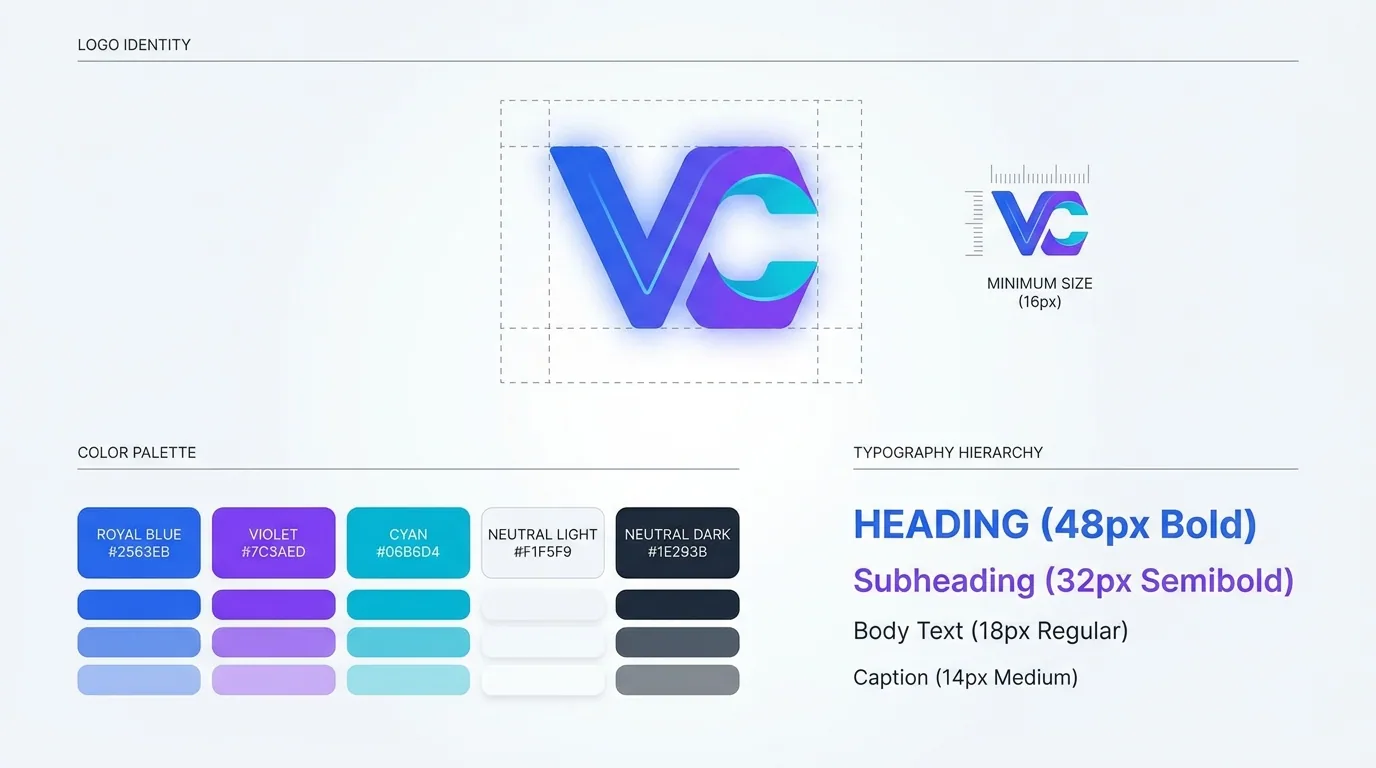
Your color palette needs exact values, not vibes. Document HEX for digital, RGB for screens, and CMYK for print, and assign roles — which color is primary, which is for accents, which is for backgrounds. For typography, choose a small, deliberate set of typefaces and define the hierarchy: heading sizes, body size, line height, and weights. The fewer the variables, the more consistent the output.
Do not forget brand voice
Visual identity gets most of the attention, but brand voice is what makes your words sound like you. Define your tone — are you playful or precise, warm or authoritative? — and give concrete examples of how to phrase things and how not to. This section is increasingly critical because AI writing tools now produce huge volumes of brand copy, and they need a clear voice definition to stay on-brand.
Your brand is not just how you look — it is how you sound. A style guide that ignores voice only documents half the brand.
— Lena Vasquez, Creative Director, Fryntavo
Include practical writing rules too: how you handle capitalisation, punctuation, the words you embrace, and the words you avoid. A few sharp do/don't pairs teach voice faster than paragraphs of theory. When the voice is documented, every channel — from the website to a support reply — reinforces the same personality.
How to create your brand style guide step by step
Building a guide is a structured process, not a burst of inspiration. Work through it in order and you will end up with a document people actually use rather than a beautiful PDF nobody opens.

- Audit your current brand — gather every existing asset and note where things are inconsistent.
- Clarify the foundation — write your mission, values, personality, and audience in plain language.
- Define each visual element — finalise logo rules, colors, typography, and imagery with exact specs.
- Write the voice section — capture tone and writing rules with clear do and don't examples.
- Show it in action — add real application mockups so people see how the system works together.
- Make it accessible — publish it where the whole team and partners can find and use it easily.
If your brand is new, building the visual identity and the guide together is the most efficient path — and exactly what we deliver through our graphic design service, so the system and its rulebook arrive as one coherent package rather than being reverse-engineered later.
Keeping your brand guidelines alive
A style guide is not a one-time deliverable — it is a living document. Brands evolve, new channels appear, and rules need refreshing. Review the guide at least once a year, version it clearly, and update it whenever you add a major asset or platform so it never drifts out of date.
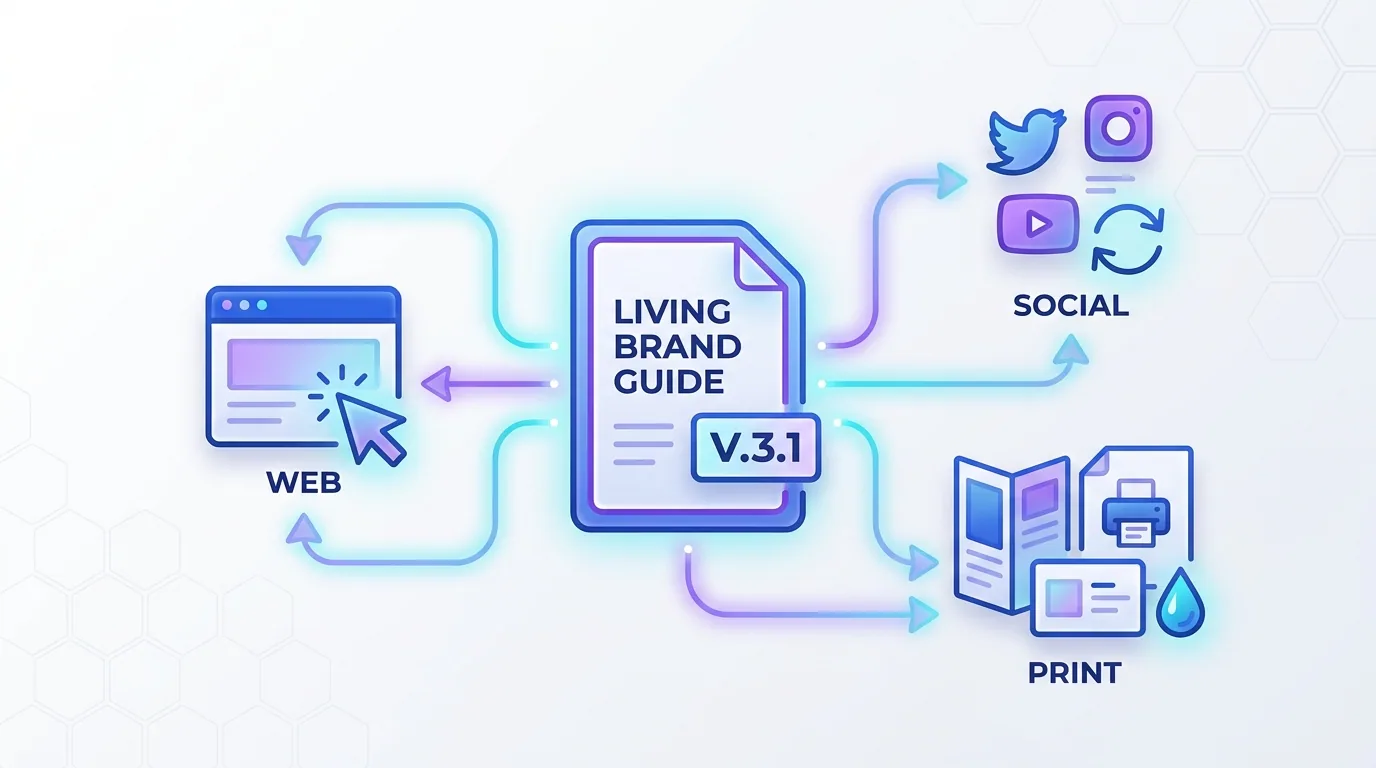
A great brand style guide turns your identity from something only the founders carry in their heads into a system anyone can apply correctly. Define your foundation, lock down logo, color, and typography, document your voice, and keep the whole thing current. Do that, and your brand will look and sound consistent everywhere — which is exactly how recognition and trust are built.
Need a brand style guide that keeps your identity consistent everywhere? Our creative team builds clear, practical brand books your whole team will actually use.
Get Your Brand Guide BuiltFrequently asked questions
What is a brand style guide?
A brand style guide, also called brand guidelines or a brand book, is a document that defines how your brand looks, sounds, and behaves, covering logo, color, typography, imagery, and voice. It serves as the single source of truth so anyone can create on-brand materials without guessing.
What should a brand style guide include in 2026?
It should include your brand foundation, logo rules, color palette with exact values, typography and hierarchy, imagery and icon style, brand voice and tone, and real application examples. Covering both the visual and verbal sides keeps the whole identity consistent.
How do I create a brand style guide?
Audit your current brand for inconsistencies, clarify your foundation of mission and values, define each visual element with exact specs, write the voice section with do and don't examples, show the system on real assets, and publish it where everyone can use it. Working in that order produces a guide people actually follow.
What is the difference between a brand style guide and a logo?
A logo is one element of your brand, while a brand style guide is the full rulebook that governs the logo plus colors, typography, imagery, and voice. The guide ensures the logo and everything around it are used consistently across all channels.
How many fonts and colors should a brand use?
Restraint reads as polish, so two to three typefaces and roughly five to seven core colors with defined roles are usually plenty. Fewer variables make it far easier to stay consistent across designers, tools, and channels.
Why is brand voice important in a style guide?
Brand voice defines how your words sound, which is half of your identity, and it has become more important now that AI writing tools produce large volumes of copy. A clear voice section with tone and writing examples keeps every channel sounding like the same brand.
How often should I update my brand guidelines?
Treat the guide as a living document and review it at least once a year, versioning it clearly and updating it whenever you add a major asset or channel. Regular maintenance keeps the rules accurate so the brand does not slowly drift out of alignment.
Can Fryntavo create a brand style guide for my business?
Yes. Fryntavo's creative team designs visual identities and builds clear, practical brand style guides your whole team and partners can follow. If your brand is new, we deliver the identity and the guide together as one coherent package. Get in touch to start.
Ready to put this into action?
Fryntavo helps brands grow with web development, SEO, marketplace management, and AI automation. Book a free, no-obligation strategy call.
Book a Free Strategy Call